Articles: Speech WritingDelivery TechniquesPowerPoint & VisualsSpeaker HabitsResources for SpeakersSpeech CritiquesBook Reviews

Articles tagged: speech examples

Studying speech examples is a great way to enhance your own speaking skills.

From great speech examples, you can learn techniques and styles to emulate.

From lousy speech examples, you can view evidence that provides you with the motivation to eliminate negative tendencies from your own speeches.

The articles below all refer to full examples of speeches, whether in text, audio, or video form:

Have you ever been to a painfully bad seminar with audience members murmuring to each other…?

  • What was that about?
  • He was all over the place today.
  • What was her point?

These are symptoms of a speech that had no clear objective and was not focused on achieving that objective.

The third Toastmasters speech project stresses the importance of clearly identifying your target objective, and then maintaining precise focus to achieve it. This article of the Toastmasters Speech Series examines the primary goals of this project, provides tips and techniques, and links to numerous sample speeches.

Continue Reading »

When you speak, does your audience get it?

If your audience doesn’t grasp your message (even though your topic is one you know they are interested in), you need to rethink the way you present it. You need to organize your ideas to promote understanding.

The second Toastmasters speech project addresses organizing your speech. This article of the Toastmasters Speech Series examines the primary goals of this project, provides tips and techniques, and links to numerous sample speeches.

Continue Reading »

Ice breaker (or Icebreaker) is a term which describes an activity which reduces tension and anxiety in a group.

Thus, it is fitting that the first Toastmaster speech project is titled The Ice Breaker.

This article of the Toastmasters Speech Series examines the primary goals of this project, provides tips and techniques, and links to numerous sample speeches.

Continue Reading »

Randy Pausch delivers a lesson laden lecture — Really Achieving Your Childhood Dreams — which will have you laughing, crying, and cherishing life.

The “elephant in the room” — Pausch’s diagnosis of terminal pancreatic cancer — serves as an emotional backdrop for this memorable lecture.

In addition to illuminating many of life’s important lessons, Randy Pausch’s last lecture also provides five lessons which can help you connect with your audience.

Continue Reading »

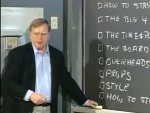
Each year, MIT professor Patrick Henry Winston delivers an open lecture entitled How to Speak.

Positive word of mouth spread over the years, and the event now draws a beyond capacity crowd with people sitting uncomfortably on steps and the floor to listen to Winston. You can learn from the master teacher from the comfort of your web browser by viewing the lecture video.

In the 45-minute lecture, Winston delivers dozens of practical tips for speaking effectively, particularly when teaching. This article highlights seven of the best.
Continue Reading »

Proper preparation prevents presentation predicaments!

Speech preparation is the most important element to a successful presentation, and also the best way to reduce nervousness and combat fear.

The Speech Preparation Series is a series of articles examining each of the six steps which are necessary to properly prepare for a speech.

These steps are briefly introduced here, and investigated in more depth in later articles:

Continue Reading »

This article reviews a fantastic talk by Majora Carter titled “Greening the Ghetto” at TED. I loved this emotionally charged talk detailing her fight for environmental justice and her efforts as director of Sustainable South Bronx.

Majora Carter’s TED talk has both incredible strengths — passion, energy, authenticity — and one unfortunate weakness — rapid speaking rate. Both extremes are worthy of public speaking analysis.

Continue Reading »

Hans Rosling presented a fantastic talk at TED. The delivery was inspiring, the mood was electric, and it was all about statistics. Yes, statistics – a topic most often associated with dry and boring presentations.

Hans Rosling uses six simple techniques for presenting data which transform a run-of-the-mill presentation into a must-see presentation.

Continue Reading »

J.A. Gamache demonstrates how to complement strong writing with powerful body language in a speech titled “Being a Mr. G.” that took first place in the 2007 Region VI Toastmasters speech contest.

This video critique analyzes many noteworthy elements of the presentation, including:

  • a memorable speech opening and closing which feature the same prop;
  • the callback technique for repetitive humor;
  • emotionally charged writing; and
  • a series of wonderfully choreographed gestures.

Continue Reading »

Steve Jobs wrote and delivered the commencement speech “Stay Hungry. Stay Foolish.” to the graduates of Stanford University on June 12, 2005.

The style and content are very different from his Apple product launch presentations, but no less worthy of study.

Noteworthy elements of this wonderful speech include:

  • strong opening;
  • simple classical structure;
  • the Rule of Three;
  • rich figures of speech; and
  • a recurring theme of birth/death/rebirth.

Continue Reading »

This article examines Al Gore’s presentation from TED in 2006. My aim is to evaluate the effectiveness of the presentation, not to express scientific or political opinion on the content of the message.

This was a fantastic presentation worthy of study. There is much to be learned from analyzing what Gore did well, and what he could have done better.

Continue Reading »

« Prev - Next »