Archives: Speech WritingDelivery TechniquesVisual AidsSpeaker HabitsResources for SpeakersSpeech CritiquesBook Reviews

Articles tagged: speech opening

Your speech opening is the second most critical part of your speech (after the speech closing).

An effective speech opening can capture the attention of the audience, establish your credibility, set the tone for your presentation, introduce key characters or concepts, or establish your line of reasoning.

A poor speech opening confuses the audience, sidetracks your talk with an irrelevant joke or story, or makes them sigh "another boring presentation..."

Examples and more information can be found in the following Six Minutes articles:

You know that the start of your presentation is critical to grab attention. [You did read Peter Jeff's recent article with 5 ways to start your speech, right?]

But do you know how to develop a mindset that will enable you to devise effective speech openings?

Carmen Taran’s Better Beginnings: How to capture your audience in 30 seconds is a one-of-a-kind book entirely dedicated to helping you master this critical speaking skill.

This article is the latest of a series of public speaking book reviews here on Six Minutes.

Continue Reading »

Ban the banalities that bog down most speech openings.

Defer the customary “nice-to-be-here” platitudes.

Direct your audience more into fawning than yawning over your speech opening. How?

Start your speech better by diving in! Instead of gingerly dipping your toes into the proverbial speaking pool, open with a splash! Pattern your platform performance after the TEASE opening which Saturday Night Live has made famous for more than 25 years.

Continue Reading »

When you speak, does your audience get it?

If your audience doesn’t grasp your message (even though your topic is one you know they are interested in), you need to rethink the way you present it. You need to organize your ideas to promote understanding.

The second Toastmasters speech project addresses organizing your speech. This article of the Toastmasters Speech Series examines the primary goals of this project, provides tips and techniques, and links to numerous sample speeches.

Continue Reading »

Randy Pausch delivers a lesson laden lecture — Really Achieving Your Childhood Dreams — which will have you laughing, crying, and cherishing life.

The “elephant in the room” — Pausch’s diagnosis of terminal pancreatic cancer — serves as an emotional backdrop for this memorable lecture.

In addition to illuminating many of life’s important lessons, Randy Pausch’s last lecture also provides five lessons which can help you connect with your audience.

Continue Reading »

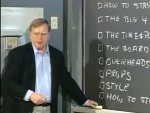
Each year, MIT professor Patrick Henry Winston delivers an open lecture entitled How to Speak.

Positive word of mouth spread over the years, and the event now draws a beyond capacity crowd with people sitting uncomfortably on steps and the floor to listen to Winston. You can learn from the master teacher from the comfort of your web browser by viewing the lecture video.

In the 45-minute lecture, Winston delivers dozens of practical tips for speaking effectively, particularly when teaching. This article highlights seven of the best.
Continue Reading »

A strong speech opening is critical to grab the attention of your audience.

Suppose you were delivering a speech to raise awareness in your community about school security. How would you open your speech?

  • I’m going to talk to you today about security in our schools…
  • School security is an important issue that we must deal with…

Both openings are direct, to-the-point, and boring! What if there was a better way?

Continue Reading »

J.A. Gamache demonstrates how to complement strong writing with powerful body language in a speech titled “Being a Mr. G.” that took first place in the 2007 Region VI Toastmasters speech contest.

This video critique analyzes many noteworthy elements of the presentation, including:

  • a memorable speech opening and closing which feature the same prop;
  • the callback technique for repetitive humor;
  • emotionally charged writing; and
  • a series of wonderfully choreographed gestures.

Continue Reading »

Steve Jobs wrote and delivered the commencement speech “Stay Hungry. Stay Foolish.” to the graduates of Stanford University on June 12, 2005.

The style and content are very different from his Apple product launch presentations, but no less worthy of study.

Noteworthy elements of this wonderful speech include:

  • strong opening;
  • simple classical structure;
  • the Rule of Three;
  • rich figures of speech; and
  • a recurring theme of birth/death/rebirth.

Continue Reading »

This article examines Al Gore’s presentation from TED in 2006. My aim is to evaluate the effectiveness of the presentation, not to express scientific or political opinion on the content of the message.

This was a fantastic presentation worthy of study. There is much to be learned from analyzing what Gore did well, and what he could have done better.

Continue Reading »

I first viewed Dick Hardt’s Identity 2.0 presentation from OSCON 2005 over two years ago. It was unlike any presentation I had ever seen at the time. I noted that I had just been injected with information.

I recently returned to the presentation with a more critical view.

  • Was the presentation really that good?
  • Was it the style, the substance, or both?
  • More importantly, what can we, as presenters, learn from it?

Continue Reading »