


How to Speak: 7 Speaking Tips from Patrick Henry Winston
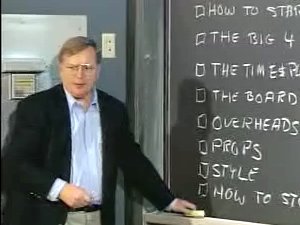 Each year, MIT professor Patrick Henry Winston delivers an open lecture entitled How to Speak.
Positive word of mouth spread over the years, and the event now draws a beyond capacity crowd with people sitting uncomfortably on steps and the floor to listen to Winston. You can learn from the master teacher from the comfort of your web browser by viewing the lecture videos.
In the 45-minute lecture, Winston delivers dozens of practical tips for speaking effectively, particularly when teaching. This article highlights seven of the best.
Seven Speaking Tips from Patrick Winston
1. Use Stories and Analogies
Winston explicitly advises his audience to use stories, and he does so himself.
One example is in the introduction. Winston skis better than gymnast Mary Lou Retton not because he is more athletic, but because he has some knowledge and he practices. This story reinforces his key message: knowledge and practice are critical to speaking success.
2. Open Your Speech Strong
Winston advises against a humorous opening, and instead recommends making a promise (stating your core message) and providing a speech outline.
He does this himself in his introduction. In addition, he opens with a great analogy between the military and educational institutions. His first words — “The uniform code of military justice states…” — grab the attention of his academic audience.
3. Use Rhetorical Devices
Winston doesn’t explicitly advise using rhetorical devices (aside from rhetorical questions), but he provides several memorable examples.
For example, here is a memorable triad which invokes the Rule of Three:
Your careers will be determined largely by how well you speak, by how well you write, and by the quality of your ideas… in that order.
Another memorable line uses contrast to achieve its effect:
What I hope to accomplish is to transmit to you […] something that will make the difference between a career-busting tragedy and a career-launching triumph.
4. Find Your Style
Winston reveals the big four around which he crafts his lectures: cycle, verbal punctuation, near miss, and rhetorical questions. More importantly, he emphasizes that these are his big four, but every speaker needs to find their own public speaking structure.
5. Use the Blackboard to Pace Your Delivery
Winston gives several reasons to use the blackboard (or whiteboard or flip chart), but the most compelling reason is to pace your delivery. The act of writing or drawing introduces delays which allow your audience to catch up and absorb the information.
6. Salute the Audience Rather than Thanking Them
Many speakers I respect take a very strong position in the debate over whether you should thank or not thank your audience. Winston takes the position that you should not thank the audience, because doing so conveys a lack of confidence that you have just delivered something valuable. Instead, he suggests that you should salute the audience.
7. Handle the Q&A Skillfully
Winston delivers several nuggets of advice for question and answer sessions. Be prepared to ask yourself the first question. Repeat the question so that the rest of the audience can hear it. Aim for a conversation, not a lecture. Stay in control. This advice agrees with a previous Six Minutes article: Leading the Perfect Q&A.
More Resources on How to Speak…
Cal Newport provides a detailed play-by-play of the 2008 Winston talk which he attended.
Please share this...
This article is one of a series of speech critiques of inspiring speakers featured on Six Minutes.
Subscribe to Six Minutes for free to receive future speech critiques.

Subscribe - It's Free!
| Subscribe via Email |  |
| Subscribe via RSS |  |
| Follow Us |


|
Similar Articles You May Like...
Find More Articles Tagged:
 3 Comments
 Recent Tweets
RT @dgende: Careers will be determined largely by how well you speak, write, and quality of your ideas… in that order. http://bit.ly/bbML7g
— Carles Caño Valls Jun 5th, 2010
How to Speak: Speaking Tips from Patrick Winston http://bit.ly/8XzxU
— Ana Luisa Santos Oct 21st, 2010
Seven speaking tips – from a famous talk given at MIT every year by CS prof Patrick Winston http://t.co/xQfzHKNfM0
— @stevenstrogatz Sep 5th, 2013
RT @stevenstrogatz: Seven speaking tips – from a famous talk given at MIT every year by CS prof Patrick Winston http://t.co/xQfzHKNfM0
— @PatGrew Sep 5th, 2013
RT @stevenstrogatz: Seven speaking tips – from a famous talk given at MIT every year by CS prof Patrick Winston http://t.co/xQfzHKNfM0
— @_fabiosje Sep 5th, 2013
RT @stevenstrogatz: Seven speaking tips – from a famous talk given at MIT every year by CS prof Patrick Winston http://t.co/xQfzHKNfM0
— @aknxy Sep 5th, 2013
RT @stevenstrogatz: Seven speaking tips – from a famous talk given at MIT every year by CS prof Patrick Winston http://t.co/xQfzHKNfM0
— @ristuart Sep 6th, 2013
How to Speak: Speaking Tips from Patrick Winston https://t.co/y13GEHoFQY by @6minutes
— @albmllt Oct 30th, 2016
How to Speak: 7 Speaking Tips from Patrick Henry Winston https://t.co/F4XcHvRfYi by @6minutes
— SparklingSpeech (@SparklingSpeech) Oct 31st, 2016
How to Speak: 7 Speaking Tips from Patrick Henry Winston https://t.co/ZLOJ3j3FPn by @6minutes
— @gnaixx Jan 20th, 2019
 2 Blog Links




Andrew, thanks a ton for the breakdown of this lecture! Great stuff.
I realy Apreciete The lessons I Have had from Your Articals, I Have Learnt A Lot And It Will Definatly Help Me A lot In My Public Speaking Career, Thank You
I appreciate the excellent summary of Dr. Winston’s speech, but I don’t see much in the way of critique. For instance in item 6, how did he salute the audience? Is there anything that might have improved the speech for you?