


Speak Like Churchill, Stand Like Lincoln: Book Review
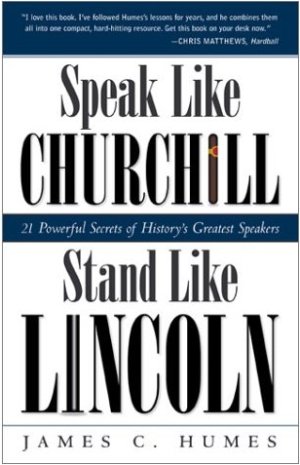
Speak Like Churchill, Stand Like Lincoln came to me as a great Christmas gift — a stocking stuffer which will improve my speaking skills considerably.
I was skeptical at first. I guessed that this was another stuffy book filled with speeches and anecdotes from famous speakers who lived so long ago that their speeches are part of history and their anecdotes are no longer relevant. That’s what I thought as I opened the book.
What I discovered is not really a “book full of speeches and anecdotes” (although there are many, many speech excerpts and anecdotes). Rather, I discovered a practical book of speaking techniques that will bolster the repertoire of any speaker who aims to lead.
About the Author – James Humes
Author James Humes knows what he is talking about. He has written speeches for five American Presidents. He is a respected authority on the speaking habits of Winston Churchill, Abraham Lincoln, Benjamin Franklin, Ronald Reagan, and others. He is the author of many public speaking books, including several on these great orators alone.
Contents — Speak Like Churchill, Stand Like Lincoln
Speak Like Churchill, Stand Like Lincoln makes for easy reading with 21 chapters averaging about 10 pages each. Each chapter follows a straightforward pattern:
- Introduce one simple speaking technique;
- Surround it with demonstrative quotations from history’s greatest speakers;
- Summarize the technique in simple and memorable language; and
- Show how it can be used today when writing or delivering a speech
e.g. in the remarks of a CEO speaking to a corporate audience.
The 21 chapters span the spectrum of writing, preparation, delivery, and even spontaneous speaking. This format makes it an excellent reference book to have on hand when approaching any speaking occasion.
- Power Pause
- Power Opener
- Power Presence
- Power Point (not what you think…)
- Power Brief
- Power Quote
- Power Stat
- Power Outage
- Power Wit
- Power Parable
- Power Gesture
- Power Reading
- Power Poetry
- Power Line
- Power Question
- Power Word
- Power Active
- Power Dollar
- Power Button
- Power Closer
- Power Audacity
Example: Chapter 19 – Power Button
As an example of Humes’ instructive method, consider Chapter 19 — Power Button.
Now that you have worked up a dandy Power Line [Chapter 14], you need to know how to turn it on. You have to light your line so it stands out like a neon sign.
Look, you put in some time to work for that zinger of a line. Don’t you want to make sure it really registers? If you don’t know the secret of turning on your Power Line, you won’t turn on the audience.
The Power Button says to the audience “Ready — Set — Listen” to set them up for the Power Line that follows.
When writing an article, you can italicize. You can underline. But how can you italicize or underline in a talk? Listeners cannot hear the underlining of a sentence.
A lot of you may use a highlighter pen to emphasize a significant line when you read a report or survey. Well, the Power Button phrase is your highlighter pen, illuminating the Power Line that follows.
Humes highlights several examples. In these famous speech lines, the Power Button is in CAPITALS, while the Power Line (the one we remember) follows.
Winston Churchill:
I WOULD SAY TO THE HOUSE AS I SAID TO THOSE WHO JOINED THIS GOVERNMENT [pause]
I have nothing to offer but blood, toil, and sweat.
Patrick Henry:
I KNOW NOT WHAT OTHERS SAY, BUT AS FOR ME, [pause]
Give me liberty or give me death.
John Kennedy:
AND SO MY FELLOW AMERICANS: [pause]
Ask not what your country can do for you — ask what you can do for your country.
Five Reasons Why You Need to Read This Book
- It delivers practical advice for speakers of all levels.
- It shows how to apply the master tips and tricks apply to your speeches.
- It emphasizes techniques to speak the language of leadership like a classical orator.
- It is an entertaining historical view of history’s greatest speakers.
- The author’s experience and expertise is unparalleled.
This is a book that I will read again and again. As one of my most used public speaking books, I will reference the advice within each time I prepare for a speech.
I wholeheartedly recommend reading this book to improve your public speaking skills.
Reviews from Public Speaking Experts
It’s an easy read from a literary perspective and it makes practical sense from a speaking perspective.
The book is filled with practical tips for becoming an engaging speaker and driving your message home.
Please share this...
Get Your Copy or Read Other Reviews
|
This article is one of a series of public speaking book reviews featured on Six Minutes.
Subscribe to Six Minutes for free to receive future book reviews.

Subscribe - It's Free!
| Subscribe via Email |  |
| Subscribe via RSS |  |
| Follow Us |


|
Similar Articles You May Like...
Find More Articles Tagged:
 5 Comments
 Recent Tweets
Want to hone your public speaking skills, and get ready for the 2013 Toastmasters year? Check out this great… http://t.co/U4yvEZsr
— R/Hm Toastmasters WA Dec 28th, 2012
Speak Like Churchill, Stand Like Lincoln: Book Review http://t.co/QvnKsxxONd via @6minutes
— @india58 Feb 8th, 2014
Want to improve your speeches? Clear tips in this book Speak like Churchill | Stand like Lincoln http://t.co/UUOgJjcq2Y
— @KateLeeComms Sep 6th, 2015
 1 Blog Link




This is one of my prefered books from the 15 I read the last few months. It is clear and goes to the point in each chapter, expaining clearly and giving examples from history to today.
Your article is very clear!
I have already used the book to give a speech in my Toastmasters Club about the Power of Pause!
Andrew, like you I came across this gem while browsing the public speaking section in the bookstore over five years ago. Winston Churchill is one of my favorite speakers of all time and as an Instructor of Communication Studies (at the time I taught an average of five sections of Public Speaking each semester) I was looking for a book that would take the anxiety out of presentation and offer my students practical tips that they could use right away.
Well, long story less long, I used the book as the text in one section in the Summer and had immediate and rewarding results. I can (and did) lecture about the importance of the basic parts of a speech (Introduction, Body, and Conclusion) but when I related Humes’ Power Pause, Power Opener, and Power Presence my students grasped the profound, but simple principles and used them! I later was able to adopt the book as one of the required texts when I became the Chairman of the Communication Studies Program at Germanna Community College in Fredericksburg, VA.
The rest is history!
Philip C. Tirpak
Dear Andrew,
Oh my goodness! What can I say about your site? It isn’t a book. It rather contains all the information found in all public speaking books. I wonder how many months a person needs to read your articles. Thank you so much.
Yesterday I started seriously reading your articles and I couldn’t read more than few articles, but hopefully i’ll read a big part of it.
My question for you is related to the book “Speak Like Churchill Stand Like Lincoln” by James Humes. This book is adopted by our university, but after looking at your site I felt that your site is much richer. For example, James humes spent all his first chapter talking about the “Pause” technique.However, according to me the pause technique can be in one page and a video can illustare this idea. He also gave examples of speeches spoken by mainly historical and politicians figures. Most of the examples have no context, this means it’s hard for the student to understand the effectiveness of the pause technique for example without understanding the background of the speech. I hope you would help me make a plan about how to tailor my public speaking course in a way that can manage between your information and the textbook (Speak Like Churchill.. or If you can assist me in how to explain in general the chapters of that book. I mean are all the examples found in the book important to be studied? Or I can just show my students a video that comprises the pause technique and then discuss this pause in few minutes. Thank for your help.
i really lov the book
Awesome review!! Very well said! Thanks for sharing.