


Speech Analysis: I Have a Dream – Martin Luther King Jr.
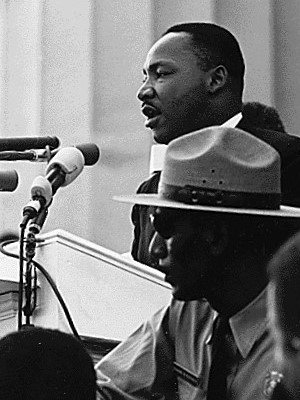
“I Have a Dream” by Martin Luther King Jr. is one of the most memorable speeches of all time.
It is worthy of lengthy study as we can all learn speechwriting skills from King’s historic masterpiece.
This article is the latest in a series of video speech critiques which help you analyze and learn from excellent speeches.
Speech Video: Martin Luther King Jr. delivers “I Have a Dream”
I encourage you to:
- Watch the video;
- Read the analysis in this speech critique;
- Study the speech text in the complete transcript; and
- Share your thoughts on this presentation.
Speech Critique – I Have a Dream – Martin Luther King Jr.
Much of the greatness of this speech is tied to its historical context, a topic which goes beyond the scope of this article.
Instead, I’ll focus on five key lessons in speechwriting that we can extract from Martin Luther King’s most famous speech.
- Emphasize phrases by repeating at the beginning of sentences
- Repeat key “theme” words throughout your speech
- Utilize appropriate quotations or allusions
- Use specific examples to “ground” your arguments
- Use metaphors to highlight contrasting concepts
Lesson #1: Emphasize Phrases by Repeating at the Beginning of Sentences
Anaphora (repeating words at the beginning of neighbouring clauses) is a commonly used rhetorical device. Repeating the words twice sets the pattern, and further repetitions emphasize the pattern and increase the rhetorical effect.
“I have a dream” is repeated in eight successive sentences, and is one of the most often cited examples of anaphora in modern rhetoric. But this is just one of eight occurrences of anaphora in this speech. By order of introduction, here are the key phrases:
- “One hundred years later…” [paragraph 3]
- “Now is the time…” [paragraph 6]
- “We must…” [paragraph 8]
- “We can never (cannot) be satisfied…” [paragraph 13]
- “Go back to…” [paragraph 14]
- “I Have a Dream…” [paragraphs 16 through 24]
- “With this faith, …” [paragraph 26]
- “Let freedom ring (from) …” [paragraphs 27 through 41]
Read those repeated phrases in sequence. Even in the absence of the remainder of the speech, these key phrases tell much of King’s story. Emphasis through repetition makes these phrases more memorable, and, by extension, make King’s story more memorable.
Lesson #2: Repeat Key “Theme” Words Throughout Your Speech
Repetition in forms like anaphora is quite obvious, but there are more subtle ways to use repetition as well. One way is to repeat key “theme” words throughout the body of your speech.
If you count the frequency of words used in King’s “I Have a Dream”, very interesting patterns emerge. The most commonly used noun is freedom, which is used twenty times in the speech. This makes sense, since freedom is one of the primary themes of the speech.
Other key themes? Consider these commonly repeated words:
- freedom (20 times)
- we (30 times), our (17 times), you (8 times)
- nation (10 times), america (5 times), american (4 times)
- justice (8 times) and injustice (3 times)
- dream (11 times)
“I Have a Dream” can be summarized in the view below, which associates the size of the word with its frequency.

Lesson #3: Utilize Appropriate Quotations or Allusions
Evoking historic and literary references is a powerful speechwriting technique which can be executed explicitly (a direct quotation) or implicitly (allusion).
You can improve the credibility of your arguments by referring to the (appropriate) words of credible speakers/writers in your speech. Consider the allusions used by Martin Luther King Jr.:
- “Five score years ago…” [paragraph 2] refers to Lincoln’s famous Gettysburg Address speech which began “Four score and seven years ago…” This allusion is particularly poignant given that King was speaking in front of the Lincoln Memorial.
- “Life, Liberty, and the Pursuit of Happiness” [and the rest of paragraph 4] is a reference to the United States Declaration of Independence.
- Numerous Biblical allusions provide the moral basis for King’s arguments:
- “It came as a joyous daybreak to end the long night of their captivity.” [paragraph 2] alludes to Psalms 30:5 “For his anger is but for a moment; his favor is for a lifetime. Weeping may linger for the night, but joy comes with the morning.“
- “Let us not seek to satisfy our thirst for freedom by drinking from the cup of bitterness and hatred.” [paragraph 8] evokes Jeremiah 2:13 “for my people have committed two evils: they have forsaken me, the fountain of living water, and dug out cisterns for themselves, cracked cisterns that can hold no water.“
- More biblical allusions from King’s “I Have a Dream” speech can be found here.
Lesson #4: Use specific examples to “ground” your arguments
Your speech is greatly improved when you provide specific examples which illustrate your logical (and perhaps theoretical) arguments.
One way that Martin Luther King Jr. accomplishes this is to make numerous geographic references throughout the speech:
- Mississippi, New York [paragraph 13]
- Mississippi, Alabama, South Carolina, Georgia, Louisiana [14]
- Georgia [18]
- Mississippi [19]
- Alabama [22]
- New Hampshire [32], New York [33], Pennsylvania [34], Colorado [35], California [36], Georgia [37], Tennessee [38], Mississippi [39]
Note that Mississippi is mentioned on four separate occasions. This is not accidental; mentioning Mississippi would evoke some of the strongest emotions and images for his audience.
Additionally, King uses relatively generic geographic references to make his message more inclusive:
- “slums and ghettos of our northern cities” [paragraph 14]
- “the South” [25]
- “From every mountainside” [40]
- “from every village and every hamlet” [41]
Lesson #5: Use Metaphors to Highlight Contrasting Concepts
Metaphors allow you to associate your speech concepts with concrete images and emotions.
To highlight the contrast between two abstract concepts, consider associating them with contrasting concrete metaphors. For example, to contrast segregation with racial justice, King evokes the contrasting metaphors of dark and desolate valley (of segregation) and sunlit path (of racial justice.)
- “joyous daybreak to end the long night of their captivity” [paragraph 2]
- “the Negro lives on a lonely island of poverty in the midst of a vast ocean of material prosperity” [3]
- “rise from the dark and desolate valley of segregation to the sunlit path of racial justice” [6]
- “This sweltering summer of the Negro’s legitimate discontent will not pass until there is an invigorating autumn of freedom and equality.” [7]
- “sweltering with the heat of oppression, will be transformed into an oasis of freedom and justice.” [19]
How can you employ contrasting metaphors in your next speech?
Speech Transcript: I Have a Dream – Martin Luther King Jr.
Note: The formatting has been added by me, not by MLK, to highlight words or phrases which are analyzed above.
[1] I am happy to join with you today in what will go down in history as the greatest demonstration for freedom in the history of our nation.
[2] Five score years ago, a great American, in whose symbolic shadow we stand today, signed the Emancipation Proclamation. This momentous decree came as a great beacon light of hope to millions of Negro slaves who had been seared in the flames of withering injustice. It came as a joyous daybreak to end the long night of their captivity.
[3] But one hundred years later, the Negro still is not free. One hundred years later, the life of the Negro is still sadly crippled by the manacles of segregation and the chains of discrimination. One hundred years later, the Negro lives on a lonely island of poverty in the midst of a vast ocean of material prosperity. One hundred years later, the Negro is still languished in the corners of American society and finds himself an exile in his own land. And so we’ve come here today to dramatize a shameful condition.
[4] In a sense we’ve come to our nation’s capital to cash a check. When the architects of our republic wrote the magnificent words of the Constitution and the Declaration of Independence, they were signing a promissory note to which every American was to fall heir. This note was a promise that all men, yes, black men as well as white men, would be guaranteed the “unalienable Rights” of “Life, Liberty and the pursuit of Happiness.” It is obvious today that America has defaulted on this promissory note, insofar as her citizens of color are concerned. Instead of honoring this sacred obligation, America has given the Negro people a bad check, a check which has come back marked “insufficient funds.”
[5] But we refuse to believe that the bank of justice is bankrupt. We refuse to believe that there are insufficient funds in the great vaults of opportunity of this nation. And so, we’ve come to cash this check, a check that will give us upon demand the riches of freedom and the security of justice.
[6] We have also come to this hallowed spot to remind America of the fierce urgency of Now. This is no time to engage in the luxury of cooling off or to take the tranquilizing drug of gradualism. Now is the time to make real the promises of democracy. Now is the time to rise from the dark and desolate valley of segregation to the sunlit path of racial justice. Now is the time to lift our nation from the quicksands of racial injustice to the solid rock of brotherhood. Now is the time to make justice a reality for all of God’s children.
[7] It would be fatal for the nation to overlook the urgency of the moment. This sweltering summer of the Negro’s legitimate discontent will not pass until there is an invigorating autumn of freedom and equality. Nineteen sixty-three is not an end, but a beginning. And those who hope that the Negro needed to blow off steam and will now be content will have a rude awakening if the nation returns to business as usual. And there will be neither rest nor tranquility in America until the Negro is granted his citizenship rights. The whirlwinds of revolt will continue to shake the foundations of our nation until the bright day of justice emerges.
[8] But there is something that I must say to my people, who stand on the warm threshold which leads into the palace of justice: In the process of gaining our rightful place, we must not be guilty of wrongful deeds. Let us not seek to satisfy our thirst for freedom by drinking from the cup of bitterness and hatred. We must forever conduct our struggle on the high plane of dignity and discipline. We must not allow our creative protest to degenerate into physical violence. Again and again, we must rise to the majestic heights of meeting physical force with soul force.
[9] The marvelous new militancy which has engulfed the Negro community must not lead us to a distrust of all white people, for many of our white brothers, as evidenced by their presence here today, have come to realize that their destiny is tied up with our destiny. And they have come to realize that their freedom is inextricably bound to our freedom.
[10] We cannot walk alone.
[11] And as we walk, we must make the pledge that we shall always march ahead.
[12] We cannot turn back.
[13] There are those who are asking the devotees of civil rights, “When will you be satisfied?” We can never be satisfied as long as the Negro is the victim of the unspeakable horrors of police brutality. We can never be satisfied as long as our bodies, heavy with the fatigue of travel, cannot gain lodging in the motels of the highways and the hotels of the cities. We cannot be satisfied as long as the negro’s basic mobility is from a smaller ghetto to a larger one. We can never be satisfied as long as our children are stripped of their self-hood and robbed of their dignity by signs stating: “For Whites Only.” We cannot be satisfied as long as a Negro in Mississippi cannot vote and a Negro in New York believes he has nothing for which to vote. No, no, we are not satisfied, and we will not be satisfied until “justice rolls down like waters, and righteousness like a mighty stream.”
[14] I am not unmindful that some of you have come here out of great trials and tribulations. Some of you have come fresh from narrow jail cells. And some of you have come from areas where your quest — quest for freedom left you battered by the storms of persecution and staggered by the winds of police brutality. You have been the veterans of creative suffering. Continue to work with the faith that unearned suffering is redemptive. Go back to Mississippi, go back to Alabama, go back to South Carolina, go back to Georgia, go back to Louisiana, go back to the slums and ghettos of our northern cities, knowing that somehow this situation can and will be changed.
[15] Let us not wallow in the valley of despair, I say to you today, my friends.
[16] And so even though we face the difficulties of today and tomorrow, I still have a dream. It is a dream deeply rooted in the American dream.
[17]I have a dream that one day this nation will rise up and live out the true meaning of its creed: “We hold these truths to be self-evident, that all men are created equal.”
[18] I have a dream that one day on the red hills of Georgia, the sons of former slaves and the sons of former slave owners will be able to sit down together at the table of brotherhood.
[19] I have a dream that one day even the state of Mississippi, a state sweltering with the heat of injustice, sweltering with the heat of oppression, will be transformed into an oasis of freedom and justice.
[20] I have a dream that my four little children will one day live in a nation where they will not be judged by the color of their skin but by the content of their character.
[21] I have a dream today!
[22] I have a dream that one day, down in Alabama, with its vicious racists, with its governor having his lips dripping with the words of “interposition” and “nullification” — one day right there in Alabama little black boys and black girls will be able to join hands with little white boys and white girls as sisters and brothers.
[23] I have a dream today!
[24] I have a dream that one day every valley shall be exalted, and every hill and mountain shall be made low, the rough places will be made plain, and the crooked places will be made straight; “and the glory of the Lord shall be revealed and all flesh shall see it together.”
[25] This is our hope, and this is the faith that I go back to the South with.
[26] With this faith, we will be able to hew out of the mountain of despair a stone of hope. With this faith, we will be able to transform the jangling discords of our nation into a beautiful symphony of brotherhood. With this faith, we will be able to work together, to pray together, to struggle together, to go to jail together, to stand up for freedom together, knowing that we will be free one day.
[27] And this will be the day — this will be the day when all of God’s children will be able to sing with new meaning:
[28] My country ’tis of thee, sweet land of liberty, of thee I sing.
[29] Land where my fathers died, land of the Pilgrim’s pride,
[30] From every mountainside, let freedom ring!
[31] And if America is to be a great nation, this must become true.
[32] And so let freedom ring from the prodigious hilltops of New Hampshire.
[33] Let freedom ring from the mighty mountains of New York.
[34] Let freedom ring from the heightening Alleghenies of Pennsylvania.
[35] Let freedom ring from the snow-capped Rockies of Colorado.
[36] Let freedom ring from the curvaceous slopes of California.
[37] But not only that. Let freedom ring from Stone Mountain of Georgia.
[38] Let freedom ring from Lookout Mountain of Tennessee.
[39] Let freedom ring from every hill and molehill of Mississippi.
[40] From every mountainside, let freedom ring.
[41] And when this happens, when we allow freedom ring, when we let it ring from every village and every hamlet, from every state and every city, we will be able to speed up that day when all of God’s children, black men and white men, Jews and Gentiles, Protestants and Catholics, will be able to join hands and sing in the words of the old Negro spiritual:
[42] Free at last! Free at last!
[43] Thank God Almighty, we are free at last!
Please share this...
This article is one of a series of speech critiques of inspiring speakers featured on Six Minutes.
Subscribe to Six Minutes for free to receive future speech critiques.

Subscribe - It's Free!
| Subscribe via Email |  |
| Subscribe via RSS |  |
| Follow Us |


|
Similar Articles You May Like...
Find More Articles Tagged:
 95 Comments
 Recent Tweets
RT @craigstacey1: GREAT place to watch Dr. King’s speech & apply his lessons to make an impact http://t.co/Rnb9tTRzkY @6minutes #DreamDay
— @TuckExecEd Aug 28th, 2013
What a great analysis: I Have a Dream – Martin Luther King Jr. http://t.co/8eY24TNwoe via @6minutes
— @marietaillard Aug 28th, 2013
Grade 12s: check out the insightful analysis of the famous “I Have a Dream” speech. It will help your Sales Pitch. http://t.co/Ad2atgo0Jd
— @sean_donaghey Oct 18th, 2013
#Speech critics: Why study other speakers? Here a speech analysis about “I have a dream” – Martin Luther King http://t.co/9SP47tJSYd #learn
— TheRedCarpetAcademy (@TheRCAcademy) May 6th, 2015
A rhetorical analysis of “I Have a Dream” speech https://t.co/BCVt8m3RgX
— @Ms_Krueger_HHS Jan 18th, 2016
Spend some time today with the Martin Luther King, Jr. “I Have a Dream” speech: https://t.co/j1koUpMS7C https://t.co/E05Kl0rMLd
— @ValpoLife Jan 18th, 2016
Speech Analysis: I Have a Dream – Martin Luther King Jr. https://t.co/6e37ukhLHs by @6minutes @DrCoffae #eng225 #functionalredundancy
— @JoyCamachoMSM Sep 15th, 2016
Speech Analysis: I Have a Dream – Martin Luther King Jr. https://t.co/PEkZMxQdD7 by @6minutes
— @JackwoodwardJ Jul 2nd, 2017
Here’s an insightful analysis that I share with my university #ESL classes. It’s definitely worth reading.… https://t.co/bCKCv04513
— Eric H. Roth (@compellingtalks) Jan 20th, 2019
Speech Analysis: I Have a Dream – Martin Luther King Jr.
by Andrew Dlugan read it here… https://t.co/hPTqWX1kQM
— Sandra Zimmer (@sandrazimmer) Jan 21st, 2019
 27 Blog Links




I realize that there are several good reasons that Mr. King had to stay rooted at the lectern with the microphones, yet even if he had a nice stage area with freedom to walk around and still be heard by his audience, I have a hard time imagining his speech being more powerful. It all comes down to the voice, and still more importantly, the content, rhetorical devices and structure.
When a new speaker in my club stays rooted at the podium, and the evaluator encourages him/her to move around as the number 1 critique, I sometimes would disagree.
Sure most speeches are more lighthearted than “I have a dream”, and more movement is often called for, yet remaining rooted at the lectern can often give a very good impression of being calm, stable, and anchored. Especially if one is speaking as some form of authority as Mr. King obviously was, these are good qualities.
I just wonder if there has been an unfortunate shift in the way speeches are now perceived (in Toastmasters and everywhere else) that we’ve sometimes lost sight of the fact that at the end of the day, content and substance are the MOST important, and the most memorable elements of a speech. Not whether the speaker moved around or not, not what he or she was wearing, not what he or she did with his hands (and for the record Martin Luther King Jr. did have good usage of his hands in the speech). Those are all just gravy. These classics are a nice reminder of the fact though, so thanks for including it.
One of the greatest speeches of all time and a fantastic anaysis also. Many thanks indeed for the hard work that goes in to producing such valluable insights. Rgds Vince
This was an excellent article. Thank you for posting it here for us, for it really opened my understanding to some things I’d not really seen with the eye of an aspiring, hopeful, future speech writer and speaker, nor even (to my shame), a decent listener!
To explain, I am a new Toastmaster, or Toastmaster Wannabe, I should say, and I need all the tips and help I can get. Public speaking “paralyzes” me. So thanks not only for this particular lesson, but a great big thanks for the entire web site! I have already bookmarked it.
His contribution into equality of races in America that we witness now is tremendous.
And it’s not just my opinion. That’s what famous peers said on Martin Luther King: http://www.tributespaid.com/quotes-on/martin-luther-king
That was a really good video from one of the most hard working men of all time. Without him, I’m sure slavery would be still going on. And it’s sad how right when the freedom started, he was killed, and not able to see his dream. But I’m sure he’s watching from heaven in peace.
this analysis was very helpful and had lots of good note!!!!!!!!!!!!!!!!!!!!!!!
Andrew:
Excellent critique on the content of one of the best speeches of all time.
Maybe in a previous post you critiqued the Delivery of Dr. King’s famous speech. If not, it is something you might consider writing about.
He is a master at using all the Verbal Elements of Delivery: Pronunciation and Enunciation, projection, inflectional, cadence, and the pause.
Thanks!
Fred
i found this speech very wonderfull and effective because of its words and expressions whiche were very persuasive also the manner whiche marten lother king had delivered the speesh was very amasing because it stems from heart
I have a dream comes up a lot and he wants to get the point through peoples mind and so he uses a lot of sentences because he doesn’t want to live like this or have his family and other families all across the world live the way he had to. what he is saying is I don’t want to put up with this anymore, and we people do not want to be judged by our colour, hair, or the way we look but by the way our personality is.
Metaphor: let the freedom ring.
thank you
This was a great analysis. It showed not only what a great speaker Dr. King was but also the depth of his spiritual awareness. I believe that Dr. King was a great man. He along with other brave men and women, transformed American society from a fake democracy into one in which all people can participate and achieve. The miraculous aspect of his great work is that he transformed an openly racist culture into one of tolerance almost overnight and led a spiritual transformation of our nation.
I once met Dr. King when I was a teenager. He led a protest/picket campaign against a supermarket chain, in a community where I lived that refused to hire black teenagers as “Bag boys” in its stores. I was one of those teenagers. I met him after a speech he presented at a local movie theater prior to the protest campaign. I got to talk to him one on one. I relive and retell this meeting and conversation in my book, “Talking Penny.” I’ll never forget the words he said to me.
This article is amazing, it really helped me understand King´s speech in a deeper way. Furthermore it is very good structred and short but easy to follow and to understand. Thank you for your help with that article!
Thanks for sharing this resource! I look forward to sharing it with my students.
THIS WAS GREAT HELP. Thank you so much.
i love you right now. biggest help ever on my rhetorical analysis essay for my writing class. biggest life saver. i owe you.
Thanks for your analysis of this powerful speech. I have my HS public speaking students analyze this speech, and you’ve added to what I can help them see.
Great article and website find. I’m subscribed now… How did I miss this before now?? Will promote this too.. Great blog!
It’s not about the words is it? It’s about the delivery/passion? How you deliver it – It’s not about the words?
hello andrew am s fascinated by this analysis infact am gonna peruse through like ten more times.
besides am a speaking champion in uganda but still need more of these, am gonna contest for guild presidency this year march 2011
tchao!
Why does he repeat the word justice?
This page was EXTREMELY heplful! Thank you!
Questions:
-Some examples of repetition in King’s speech were “we cannot be satisfied” and “now is the time.” This adds to the appeal of the speech because it makes it stronger and more powerful. These terms that King repeats are key words that have to do with ending racism. People remember these words and it wraps the entire speech into a couple of repetitive words. Other examples of repetition in this speech are “we must,” “go back,” and, “I have a dream.” That one repetition example was so important that it became the title of the speech. Something that I noticed about repetition is that it starts at the beginning of the sentence then continue with something different to stress the repeated term.
Wow! This Article really helped me understand this speech at a whole new level. Way to go Andrew!! Thanks so much for your help.
I once never thought that one day the speech will be suitable in my academic study, but it is so important, thank you!
I think martin’ repetition of “I have a dream” ‘s phrase is significant;by stressing on it he wants to assure the audience about his unbreakable optimism viewed as prophesy
Excellent critique. Would like to read similar critiques of his other speeches
The more memorable and more dynamic 2nd 10-minute part of the speech-which starts with the “I Have a Dream” theme-was impropmptu. It was not part of the written speech draft that Dr. King prepared and read on the podium. Essentially, Dr. King was constructing the 2nd part as he spoke.Dr. King achieved this rare feat because of the abundant collection of speech material he has assembled thru the years from prodigious reading and actual speeches delivered in other locations.
Continued…
Invariably, Dr. King was the most dynamic when he is unshackled from the written draft. While the 1st (prepared and written) part of the speech was good, the 2nd
impromptu part was much better-more like electrifying.
Dr. King’s rare genius results from his rare ability to seamlessly merge his own eloquence with the eloquence of others (direct quotes, allusions or paraphrases)> The whole eventually appears as if written by him in one coherent whole.
There are those who propound that the more memorable 2nd part was inspired at a higher level. Some use the words “divinely inspired.” Whatever its genuine nature,it is amazing than a speaker could craft an impromptu portion that would be considered a oratorical masterpiece.
How did Dr. King come to deliver the 2nd 10-minute improptu part that starts with the “I Have A Dream” segment? A gospel singer, Mahalia Jackson, sitted at his right, blurted out: “Tell them about the dream, Dr. King.” Dr. King must have heard it, as he began to articulate his “dream.” The rest is history.
it is a very nice speech
great work andrew,i am taking a course in public speaking and i absolutely love your work. i look forward to be like you one day – an excellent public speaker..
This article was very interesting and very helpful in a paper I had to write for school. Thank you for posting this.
Martin luther king jr. uses repetition to get his point across. to stop the segregation between white and african americans. one way he uses repetition is when he says “let freedom ring” four times in a row to give african americans all the rights that a white man has. the most common use of repetition is when he says “i have a dream” to show what he thinks is right, and what should change wich can grab peoples attenion
Thank you for sharing this insightful, detailed, and illuminating analysis. I will be recommending your site to my speech students.
Thank you for this excellent analysis, Andrew. I saw it in the Ragan newsletter and referenced it in my blog. I especially like your focus on repetition in speaking, a subject I harp on quite a bit.
I find this man inspirational and am choosing to wirte about him for an english literature piece. This has really started me off and has really helped. Dr. Luther King was an amazing man and he changed the way that we look at the world. He changed the world and is arguably the worlds most significant person.
this work is absolutely amazing!
I found this feature very helpful with my current linguistics topic of study.
“I have a dream” that you would be my teacher, I understand the speech after looking at your website keep up the good work.
Thank you for sharing this amazing masterpiece. It is well clarified and well presented and organised. I agree that it is one of the high standard and posh speech.
Thanks again
that was a very good speach and that martin luther king was still mostly famoum. martin was an insperation and that we should all have a dream that the nation will rise up to meet the standeds of america
thats a very good speach and my grandad would be proud of this website and of the creator
Why did King say “Five score years ago” when he could of said “One hundred years ago”
and then later, why did he say “One hundred years later” instead of “Five score years ago”? I’m analyzing his language in this speech and I came across this, so it made me wonder… anyone care to answer?
Here five scores means 20 years ago..
I studied Rev. King’s I Have a Dream speech in a writing class; it is a speech, a piece of writing, that always moves me. The anaphora is so pronounced, so captivating, the listener cannot help but be swept away. I am always in tears by the time I reach the end, and I have read this speech many times. I hope every student is given the opportunity to study these words, to understand them, and to appreciate the sacrifices made since then.
This is an excellent analysis of Dr. King’s speech! I have learned a lot, and will use it as a reference for future speeches I make.
I enjoyed this analysis. I would love to this speech highlighted with different colors like the critique on Churchill’s “iron curtain.”
I thought all five lessons were important, and easy to understand. They broke each part of his speech down in a way I wouldn’t have thought to. However, I particularly liked and took an interest in lesson 1 and 2. The repetition was strategic and purposeful rather than like in high school we were always told to use synonyms and expand our vocabulary. It was making a point, and it is true, when I think of this speech “I have a dream” is the very first thing that comes to mind, and this was a strategy and exactly what he wanted when he wrote this! Excellent!
I have read MLK’S speech several times. It is always fresh and timeless.It is the master of all speeches. The above analysis helped me to appreciate the speech than ever before.
The visual representation and summary of the frequency of word usage in the speech is a great idea. It appears to be similar to concept maps, and would be useful for both writing and analyzing speeches. It could serve as an initial framework to clear up ideas and ensure that a speech is centered around the intended themes. The quotations used, especially those from the Bible, add extra power to the speech. At that time, more Americans were familiar with the contents of the Bible and would be motivated to action at the quotations and allurement to scriptural passages. Religion is a subject that is always taken very seriously and is something people are highly passionate about, so a well-used quotation or reference can do more to persuade people many techniques.
A very good analysis of this famous speech that not only gave good advice on speech writing in general, but also helped me understand the speech on a deeper level.
I thought this analysis was absolutely amazing. I found it very insightful and gave me a look into the details of the speech. I’ve learned about MLK and the “I have a Dream” speech but I’ve never learned this much about it. This gave me a different perspective of what it actually took him to write the speech. I particularly took interest in the theme of freedom, learning what Anaphora is and the impact on the pauses, pronunciation, projection, and of course, the repetition. This was a great analysis and I think many people can learn more about the speech with this critique.
The breakdown of the speech brought things to my attention that I had otherwise over looked. It is clear that much time and consideration was put into the construction of the speech. The metaphors used, added a power to the speech that showed the commitment and passion Dr. King felt. It is also clear that he knew what he was doing. The time he took to connect things together in the speech was evident. While reviewing the video, it seemed that he kept a strong and steady pace from the beginning until almost the end; then toward the end of the speech, when he really wanted to show emphasis, his voice and physical motions showed changed to show his feelings. Something else I viewed as powerful was Dr. King’s use of examples that the audience could relate to. The use of events that had taken place pulled in more audience support, and again showed his commitment and passion.
The best speech of all time. So motivating and important. I like this new look at it too. Helps me see it in a whole new light.
I think the analysis was amazing. I’ve learned about the “I Have a Dream” speech in just about every year of school, but I have never looked this deep into it. I have listened to the speech before, but would have never understood or picked up on anything like I did after reading this. The metaphors used the allusions, and very strong arguments all came together to make a perfect speech. No wonder this is nationally known, he is a genius. His strategy to go around points that were needed to be made was phenomenal. Apart from the speech, the analysis broke it down beyond perfect to show everyone what exactly was going through Dr. King’s head. Everyone can benefit from listening to this well constructed speech and speech analysis.
Dr. Martin Luther King Jr.’s “I Have a Dream Speech,” is one of the most memorable speeches of all time. This speech was one of the main reasons for the breaking of the color barrier. Dr. King is very passionate and emotional throughout his speech, which is seen through his vocal variety, the way he emphasizes certain words, and how overall powerful he is while giving this speech. Through the use of repeating specific phrases, “Now is the time, I have a dream, Let freedom ring,” his use of allusions, and the way he uses his metaphors, really make this speech so personal. By repeating the phrases, people throughout America see how passionate he is, and he gets his point across. His use of allusions when quoting Abraham Lincoln’s Gettysburg Address, and quoting multiple biblical verses, really adds a personalized effect to Dr. King’s audience. He is stating that one of America’s former presidents, who gave the Gettysburg Address, signed the Emancipation Proclamation, and when quoting the bible verses, saying that God created man equal. Finally with his use of metaphors, Dr. King uses the phrases of dark and desolate valleys to mean segregation. Its the little things that Dr. King did to make this speech so powerful and ultimately, destroy the color barrier for the United States.
I really enjoyed this analysis of MLK’s speech. It’s really interesting that he repeats things so many times. You always hear how you should come back to a point to get that certain point across, but I never thought about going back to the same point or saying the same thing numerous times. Reading all of the statements he repeated was a huge eye opener. I also never really thought about how he brought all of this other history into his speech like the geography of the states he decribed or the statements from other important documents. This was overall a very good analysis and I actually enjoyed reading about it.
This is an outstanding speech made at a very crucial time. I feel that one of the major points is that many speakers of this time were very focused on retaliatory a acts, and specific incidences for relations to people. Though there are a few geographical references in Dr. Martin Luther Kings speech, what set it apart to me is that he took a collection of many local problems, categorized them into regions, then into speaking about the state of the nation as a whole. By doing this he gives everyone a feeling of unity and purpose, followed by relating this now entire group of people to other major historical events that people can relate to. By referring to Lincoln, this was something that people had heard personal stories and first hand accounts about their own ancestors fighting for justice. Then relating the same group to the trials of the people and perseverance of biblical characters, which are very well known, helps give credibility, a sense of relation, and a foundation to build up and succeed just as others who faced towering obstacles had overcome them. By referencing these groups and making repetitive notations from their trials to those of the current situation makes this a great speech. It not only motivated the intended audience but became, in itself, the next story that future generations could refer to in times of trial.
I thought this analysis was great. In high school we barely talked about the “I Have A Dream Speech” and it was great to finally learn about it and go into detail about the organization of the speech. I never would have noticed some of his strategies without reading this analysis. I think anyone who is attempting to write a powerful speech would benefit from watching Dr. King’s speech and reading this analysis.
I always believed that in order to speech to count it has to change the way of the people and the way that ourselves think today. Martin Luther King’s speech did just that and it was a speech that made history and really saved our society and our nation from what could have been a terrible future up until today for America.He used the term “we” the most which for a speech like this is very important because he’s addressing what he wants all America to be like. Overall, one of the greatest speeches ever to take place in history.
The “I Have a Dream” speech has always been iconic, since the day it was first given and even now. The vividness of Martin Luther King JR.’s descriptions and the strong words he chooses to express his wishes communicate on a deep level with listeners and inspire the wish for change, just as they did then. All of this combined with strong his strong voices and unique delivery style leaves listeners aching to make a change, even years after his voice rang out across the reflecting pool at the Lincoln memorial.
The “I have a Dream Speech” has been a well known speech among people for several years. I have listened to the speech before but I never picked up on certain verbal accents and change in volume throughout the speech. In the speech he kept a very good pace,but would change his volume when he was trying to get his point across. I also paid attention to the words that he choose to use because he was very good at conveying his message and I felt that his word choices were a positive factor. I also noticed that he said “we” a lot which I also liked because he was not just referring to himself, but his entire audience. This speech is a great speech and is a great tool for someone who wants to conduct a speech.
I thought that the critique was very interesing. Everyone knows that the “I Have A Dream” speech is a very memorabe one indeed. We always listened to it at school, but we never really looked into the speech with great detail so the critique really taught me a lot. I learned from this critique that Dr. Msrtin Luther King Jr. used a lot of metaphors througout his speech, and I think that’s one of the reasons the speech was so strong, and his repetition at the beginning of his sentences really caught the attention of everone listening that day, and when people listen to it today.
Andrew– an amazing analysis!!
A very good analysis to help students understand the requirements for speech writing. Students did benefit from it. thank you
This is a great article. Breaks everything down on how great this speech was and how and why it was so great. Martin Luther King used repetition in the perfect way to get his message through. The beginning of the speech had consecutive repetition which actually grabbed the audience attention. This article was extremely helpful in understanding why this speech was so great.
Thanks a lot for this well-structured analysis of the speech.
It is a speech that has touched me ever since I first encountered it as a teenager. Now being an English teacher (at a German high school) I finally get to teach young adults (like I once was) about it and your analysis is of great help to me!
This website with the critiques to the Martin Luther King speech was very useful i really enjoyed and liked it!
What a fabulous article you wrote! I will be letting my children read it.
Many many thanks for making this available to the general public.I intend to use this with my students, if I may, and shall report on their reaction.
I have read this speech over twenty times and this analysis has given me a different perspective. This analysis was inspirational and I felt as if I were reading it for the first time. was
The line “We can never be satisfied as long as the Negro is the victim of the unspeakable horrors of police brutality” is still so relevant in 2016.
I feel like this was a great speech. This man was a great man and did great things. I like when he started to talk about how every one should be free, it is true every one should have freedom no matter where your from or who you are. When he said i am free in the last word of his speech i thought that was very powerful, because that was a statement he wanted to be free so he was. I’m glad he was part of are history and that he did what he thought was right, because he has help the world out.
I agree with Andrew Dlugan, on what he believes to be the key factors or most important parts of the “I Have A Dream” speech. He gives different lessons on all parts of the speech, in which he breaks down the different aspects of them.
Lesson #2 states the important themes, phrases and words Dr. King used throughout the speech. Andrew believes that this was very important part of the speech because it’s where Dr. King emphasized what he was saying by repeating them over and over indicating the importance of it.
I think that the most important thing in this speech is when he repeats the key “theme” words. That way the people know who/what you’re talking about and whom you’re talking about. Especially with a speech like this spoken among thousands of people.
What makes this speech a great speech is that there is a lot of dedication towards equality.
This speech is great because he wants freedom and justice for all, not just for African American people.
Lesson number four was a very unique importance reflecting the “I have a dream…” speech. I believe your perspective and the way you feel in this case is very important. Especially since MLK gave specific and clarity throughout his speech. Lesson number four is all about providing examples that could give you an logical illustration of what is being said and that is specifically what makes a great speech.
This is a great speech, I liked how he used repetitiveness. It really makes a point on what he’s trying to get through.
This article is a great analysis to the speech. Martin Luther King’s speech is powerful and strongly impacting to whoever has heard or listened to it. In line 41 to me was very powerful that shows that when it would happen we would all be equal that we always were but it would finally be accepted by more. Martin Luther King is an amazing speaker and his voice was powerful and used his voice to speak what he wanted to prove.
This was a wonderful analysis to this speech. Martin Luther king’s was very powerful especially how he spoke it with ,importance and a powerful impact. My favorite line was line (7) Nineteen sixty three is not an end but a beginning. My personal preference on what it means is it is the beginning to start all over with everyone being able to be treated the same and not be judged by the color of their skin. This was a wonderful speech.
What makes “I have a dream” speech great is the fact that Martin Luther King Jr. used his voice to fight against racial segregation and discrimination. “I have a dream that my four little children will one day live in a nation where they will not be judged by the color of their skin but by the content of their character.” is my favorite quote from the speech. I believe this quote is so powerful because in this world, there are a lot of judgement on people’s appearances and having Martin Luther King Jr. lecture people on that, I believed it opened a lot of minds.
Mahalo for sharing this lesson … It’s perfect for breaking down King’s message and increasing awareness of figures of speech for students to learn to use in their own writing.
An excellent analysis.
I have a question, Why did Martin Luther King use Alabama, Georgia, and Missisipi in his speech? Please enlighten me.
Thank you
To show emphasis in the deep South,
Iam so impressed. I like the step by step approach with examples.I wish to to learn as an M.ed English student. Also,I wish to start public speaking club with students I teach and my church.I will like you to support me.
Thank you for this article.
There is a good reason why speeches like this are often presented as good examples; something to feel inspired from. It is so full of wonderful elements, like the repeated phrases for instances, which make a huge impact on the overall speech. Public speaking courses can benefit a lot from showing such an example.
” Now is the time…” is actually a form of parallel structure, not repetition.
Actually it is anaphora, and what comes after “Now is the time …” is the parallel structure. I hope it helped you.
Thank you for your inspiring analysis of this historic speech!
Hi Andrew,
This was such a great eye opener to the various mistakes I have been making in most of the speeches I have been giving!
Kudos!!!
Violet
Thank you so much for this very helpful analysis of language of Luther’s speech. I was preparaing my lesson and ı found this! I ve found lots of useful info for my students. Thank you so much 🙂
The speech analysis of Martin Luther King Jr’s famous ” I Have A Dream Speech”inspired me to teach a fabulous lesson to high school speech-language therapy students of multi-ethnic backgrounds.