


Never Read Your Speech… Never?
 Bor’-ing, adj.
- Uninteresting and tiresome; dull.
- A speaker reading their entire speech.
Presentations are more lively when a speaker speaks from the heart, from memory, or from minimal notes.
But, what if you simply must read an entire speech or a portion of a speech from script? Is there anything you can do to salvage a successful presentation?
In an article devoted to mastering the teleprompter, Pete Ryckman reminds us that:
[…] sooner or later, you’ll need to give a speech word-for-word from a script.
Maybe your employer or a legal team insists that the speech be read from a script. Maybe the context is too delicate to allow for any ad-lib. Maybe you were not given adequate time to practice thoroughly.
When you simply must read from a script, there are some things you can do to salvage your speaking reputation in this scenario:
- Author James Humes devotes an entire chapter of Speak Like Churchill, Stand Like Lincoln to a technique used by master speakers. The key of this technique is to only speak to the audience when your eyes are up off the text.
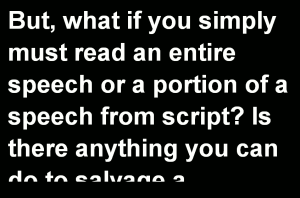
- Practice with a teleprompter so that when you need to use it, you will already be comfortable with it. CuePrompter.com is a free resource which simulates the teleprompter experience. The graphic accompanying this article is a snapshot from this tool.
- As much as possible, compensate for your lack of eye contact with excellent vocal variety. This will draw audience attention away from the script you are reading and toward the message you are conveying. To do this, you will need to practice a few times through the script; otherwise, you will almost certainly be monotone and flat.
- Similarly, compensate with broad gestures and other movement. Lack of movement will certainly make the eyes of your audience droopy.
Remember, this advice is only for those very rare instances when you must read from a script. In all other cases, don’t do it. People don’t like being read to in a presentation. Put in the necessary preparation time to ensure that you do not need to torture your audience.
Please share this...
This is one of many public speaking articles featured on Six Minutes.
Subscribe to Six Minutes for free to receive future articles.

Subscribe - It's Free!
| Subscribe via Email |  |
| Subscribe via RSS |  |
| Follow Us |


|
Similar Articles You May Like...
Find More Articles Tagged:
 7 Comments
 Recent Tweets
Never Read Your Speech… Never? http://t.co/46iGa3lT via @6minutes
— Karen Singbeil Mar 16th, 2012
Never Read Your Speech… Never? http://t.co/46iGa3lT via @6minutes
— IanHawes Mar 16th, 2012
Practicing my speech for Saturday and found this via my procrastination. Never Read Your Speech… Never? http://t.co/ebHdloDE via @6minutes
— Pattie Rydlun Aug 13th, 2012
Never Read Your Speech… Never? http://t.co/LyfmJSdvWU via @6minutes
— @markdorsey2 Oct 17th, 2013
 1 Blog Link



The only time it is acceptable to read from a text during a speech is when you are doing a verbatim quote of another person’s speech.
Tim,
Excellent points all!
I discourage my clients from trying to memorize a script because if they make the slightest ‘mistake’, missing a piece or getting out of order, they tend to panic and get flustered. I recommend that they spend time writing their talk and then distill it to key bulleted points and print those out to use only as a reference if they get stuck or start to veer offtrack.
A few comments on your suggestions:
#1) Author James Humes technique of only speaking “to the audience when your eyes are up off the text.”
This is a technique that I learned as an actor doing “cold-readings” and I recommend to all my clients. I’ve concocted a TLA (Three Letter Acronym) as a mnemonic to help speakers remember this principle:
R-C-S (Read-Connect-Speak). Read off your notes or script in silence, Connect with your audience through eye contact, then Speak.
#3) “compensate for your lack of eye contact with excellent vocal variety”
This is good coaching regardless of whether they are reading or not.
Fully 80 – 90% of the presenters that I observe do not expend enough vocal energy and do not speak with vocal dynamism. Hence, they come across as uninvolved, uninteresting, and unenthusiastic.
#4) “compensate with broad gestures and other movement”
The human eye is deeply sensitive to movement. That part of our ‘operating system’ is based in our brain stem, which developed very early in the history of our species. Simply, if we were not attuned to movement, as a slow-footed and weaker animal, we would have been lunch a long time ago.
There have been documented cases of patients in hospitals with little to no brainwave activity whose open eyes will still follow movement in a room.
Sorry, Andrew. I don’t know where I got “Tim” from … *wiping egg from face*
Again, excellent post!
Andrew – Thank you for this terrific post. It is great to know that there is so much research and attention devoted to helping people engage while reading from a script. I just blogged about this exact topic – sarahgershman.blogspot.com.
I would really appreciate feedback.
Warmly,
Sarah
Mr. Dlugan, I must disagree with your premise concerning avoiding teleprompter usage. It’s interesting that you start your points off referring to Sir Winston Churchill, one of the most eloquent and moving speakers in history. What you fail to realize is that Churchill read every speech he gave. As a world leader, had he lived today, he would be using a teleprompter. The key to Churchill’s moving delivery was three-fold. First, he prepared his speeches, not some speech writer. He was intimately knowledgeable concerning not only the concepts but the words in his speech. Second, he practiced his speeches incessantly. Someone once asked Churchill how long he prepared for a 45 minute speech. His answer was a minimum of 18 hours! He even practiced “mistakes” into his speeches. One time he was supposed to refer to “the internal combustion engine” and instead said “the infernal, I mean internal combustion engine” which receievd a huge laugh. His secretary later shared she heard him practicing that in advance. Churchill would practice in front of mirrors perfecting his facial expressions. F. E. Smith, 1st Earl of Birkenhead, a statesman, lawyer, orator in his own right, and personal friend of Churchill said “Winston has spent the best years of his life writing impromptu speeches.” The last point is that he performed his speeches. He varied his pace and he varied his volume. When he prepared his speeches he put them in what he called “Psalm form” indicating cadence and gestures. Because of these three things he moved a nation with his delivery. No one would ever accuse Churchill of being boring. I think you would do well to rethink your position on this matter.
If everyone reading a speech did it like Winston Churchill, this article would not be needed.
However, most people reading a speech do not rehearse, do not vary their vocal delivery, and do not make any attempt to connect with their audience. My hope in writing this article is simply to encourage speakers to do so if they choose to read their speech.
when anyone give presentation,eye contact is the main thing which gives attention.Never read text as it is in the slides.But in this blog not mentioned about drama that also makes your presentation successful.