


How to Connect With Your Audience by Moving Closer
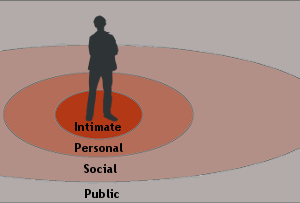 Most speakers begin their careers gratefully clutching the sides of a lectern, happy to hide behind it for that little extra bit of security in a tense situation. But, by now you know that you should not stay behind the lectern. But why?
And as you get more advanced in your speaking, and comfortable with the stage, how should you move in relation to the audience?
Is it a good idea to move deep into the audience or not? What about those situations where it seems awkward to get to the audience at all, either because of the logistics of the room or the positioning of your listeners?
Human Interaction Zones
In establishing a few rules for the effective choreography of a speech, several key insights from research on non-verbal communications will help. The first comes from Edward T. Hall and his classic work The Silent Language. He described 4 zones of space between people:
- Twelve feet or more is public space.
- Twelve feet to 4 feet is social space.
- Four feet to a foot and a half is personal space.
- And a foot and a half to zero is intimate space.
The exact dimensions of these zones vary a little from one culture to another, but all cultures have them.

Audience Personal Space is the Key To Connecting
Sharing public space is quite low-key for us – we’re not very interested in people in that space simply because they’re too far away to be important. Social space is a little warmer, but it’s not until someone moves into our personal space that we really begin to pay attention. And of course, when someone is in our intimate space he or she has all our focus.
“You can’t make a real impact on people unless you can get into their personal space.”
The bottom line is that nothing significant happens between people except in personal and intimate space. Since public speakers can’t get into intimate space — it violates something quite profound — that leaves personal space.
Here’s the way to think about it: you can’t make a real impact on people unless you can get into their personal space.
By now, you’re thinking that this zone research creates a real problem for public speakers. You obviously can’t get into the personal space of everyone in the audience; you’d be running around like a mad person. Won’t the majority of the audience feel left out?
Your Audience Shares Emotions
I’ll get to the logistics in a minute, but first there’s a nice bit of recent brain research that sheds more light on the subject. An Italian group of brain researchers have studied mirror neurons (See: Mirrors in the Brain: How Our Minds Share Actions, Emotions, and Experience). It turns out that when someone near us experiences an emotion, a special kind of neuron – a mirror neuron – fires in our head giving us the same emotion. It’s how we’re able to be empathetic as a species, how we can feel other people’s pain and joy, how we can care for others, and so on.
In this case, it means that if a speaker focuses his or her attention on an audience member, all the people sitting near that lucky individual will experience the same thrill of attention. The effect diminishes over space, but it’s quite powerful and it means that to give attention to a great majority of the audience, you don’t have to run around the room.
Trust (and Connection) Increases as Distance Decreases
We can then add to these research insights with a third phenomenon: our trust of people increases when they move closer to us, and decreases as they move away from us.
“Moving into the audience, and getting into the personal space of selected audience members, is the only effective way to move beyond bland and make a world-changing impression on people.”
By now a picture should be emerging of why it’s so important to move into an audience to connect with them – and why you shouldn’t believe that old misconception that other audience members will feel left out if you focus on several people in the room. Moving into the audience, and getting into the personal space of selected audience members, is the only effective way to move beyond bland and make a world-changing impression on people. And the only reason to give a speech is to change the world, right?
Okay, But How Do You Move Closer to the Audience?
Okay, you say, but we’re still left with the logistics.
- What if I’m speaking in a ballroom with all those round tables and people facing every which way – how do I negotiate that space?
- What if I’m up on a stage and jumping down is hazardous to my health?
- What about those times I’m on a camera for the people in the back – the AV people tell me not to go off the stage because they can’t follow me. What do I do then?
“Use your body like a punctuation mark to add clarity and impact to your speaking.”
In over 20 years of work as a speaker and as a coach of speakers, I have seen virtually every imaginable room configuration. Many of them make it extremely difficult for speakers to move successfully into the audience. In those cases, you just have to do the best you can. And the best may only be moving to the edge of the stage. But even that will increase the audience’s trust in you, and their sense of connection, because humans are very quick to notice when someone is moving toward or away from them, even in small amounts.
Understanding how mirror neurons work lets you know why working the audience is effective even if you only get close to a few people. Nonetheless, you don’t want to spend a lot of time deep in an audience so that your back is turned away from a significant percentage of your listeners. Turning your back on people sends out a powerful message of lack of interest or disengagement.
“Moving toward the audience – closing the distance – says, ‘this is important.’”
This is especially true in a room filled with those round tables, where it seems like you’re always turning away from someone. With that kind of configuration, your should spend most of your time at the front of the room, approaching the tables you can easily get to. Try to get to each side of the room. The audience will appreciate both that you’ve attempted to reach them and that you haven’t spent a lot of time lost deep in the thicket of tables.
You also don’t want to spend too much time on one particular audience member. The exact timing depends on the nature of your speech, and the kinds of interactions you have, but as a rule of thumb, think in terms of 30 seconds to a minute, not much more. Audience members will feel left out if you allow one person to monopolize your attention for too long.
It’s a matter of (1) tact and (2) quick thinking on your feet. You need to size up the room, figure out how you’re going to move in it, and plan how much you can work the audience.
The goal should always be to move toward your audience, even if it’s only a few feet, on points in your talk that you want to emphasize, or when you want to interact with audience members. Moving toward the audience – closing the distance – says, “this is important.” Moving away says the opposite. So use your body like a punctuation mark to add clarity and impact to your speaking. The choreography should be in service to the message. Always.
What Do You Think?
As a speaker, has moving toward the audience been a rewarding or frustrating experience?
As an audience member, what do you like or dislike when the speaker steps into the audience?
Please share this...
This is one of many public speaking articles featured on Six Minutes.
Subscribe to Six Minutes for free to receive future articles.

Subscribe - It's Free!
| Subscribe via Email |  |
| Subscribe via RSS |  |
| Follow Us |


|
Similar Articles You May Like...
Find More Articles Tagged:
 11 Comments
 Recent Tweets
RT @PublicSpeakFun: Excellent article by Nick Morgan of @PublicWords on moving closer to the audience. Read and share! http://bit.ly/7V35V3
— Speakers With Impact Oct 18th, 2010
RT @6minutes How to Connect With Your Audience by Moving Closer http://bit.ly/619YxA
— Lee ByungWoo(이병우) Mar 19th, 2011
How to Connect With Your Audience by Moving Closer http://t.co/jaU3lNCx #presentation #learning
— Heather Lyons Oct 20th, 2011
How to Connect With Your Audience by Moving Closer http://t.co/jaU3lNCx #presentation #learning
— Toastmasters 2.0 Oct 25th, 2011
How to gain a stronger connection with your audience… http://t.co/5q5LZ97K #eventprofs
— Welcome Nov 2nd, 2011
How to Connect With Your Audience by Moving Closer http://t.co/dtSlcFvV via @6minutes
— Message Masters Dec 21st, 2011
“@MMasters7809: How to Connect With Your Audience by Moving Closer http://t.co/9o6dox5d via @6minutes” Excellent!
— PublicSpeakingFun Dec 21st, 2011
How to Connect With Your Audience by Moving Closer http://t.co/bf5sOhAT via @6minutes
— Peter Krutý Aug 23rd, 2012
How to Connect With Your Audience by Moving Closer http://t.co/R0uPup7q
— Sarah Denholm Nov 8th, 2012
Goeie Tips voor presentaties! https://t.co/1w8gyT16mr
— @w_willemsen Nov 21st, 2015
 2 Blog Links




Another great post.
Moving forward says “Hi this is me,I’m pleased to be here”,”I want to communicate effectively with you”,and” I know my stuff and I’m not for hiding from you behind a podium”.
Walk on,stop,face the audience,centre yourself,smile, pause and move forward as you start to speak…..
You always have such great info in your posts. Thanks for sharing your expertise with us in so many interesting ways. Actors and singers usually have to deal with making an impact from a distance but they increase the sense of being in someone’s personal space by (1) making sure they “find their light” (I’ve seen far too many presenters speaking in the dark because they felt they had to stay in a particular spot on stage or were glued to the podium..or were just unaware of the importance of being seen) and (2) by making eye contact and connecting with individuals in the audience whenever possible…no doubt working with that mirror effect.
Really terrific piece! Thank you. I was once giving a training and asked the group (about 20 people sitting in a semi-circle) just to lean forward in their chairs. The change in energy was palpable. I have found that if the speaker is getting more personal in his/her content, it is especially important to physically move closer to the audience.
Great points.
I like the concept of the Mirror neurons. Had not heard of them 2 weeks ago, but this is the 3rd places I have come across a discussion about them. They are fascinating to understand!
Stories are another great way to activate mirror neurons.
Not only moving into an audience but also making honest eye contact and even speaking directly with an audience member are underutilized tools to connect and engage your audience. Thanks for the great post!
JT
In addition to moving closer to the audience, where speakers can “find their light” it can be helpful to look for places on stage and in the audience that are better lit. I once spoke on a stage with overhead pot lights. If I moved directly below the light, it made dark shadows on my face, but if I moved slightly away from the audience, it made my face glow. During a poignant moment in the speech, I moved into the light until my face glowed, creating a magic moment. Move closer, find your light, and find THE lights.
It’s also about what you do with your hands in connecting to the audience as well as how you use the space. Nothing worse than someone fidgeting. We teach using Satir categories to better communicate from a stage. http://www.youtube.com/watch?v=cbkSGmjT9ss
I am a freelance Management trainer and a guest faculty to Management and Engineering Colleges. During my lectures, I have always found that moving closer to the audience builds a rapport between speaker and audience. In my each lecture, I do same and students like it. But doing this is possible when one has a great confidence and is witty and take along the audience with him/her.
I’m preparing a training a program and lucky to find this post. It wakes up me in some areas which i know the issue existence but not knowing how to solve it. I’m happy to borrow the knowledge and share with my club members.*_* thank you Nick.
Helpful article, thanks !
this really stands out for me